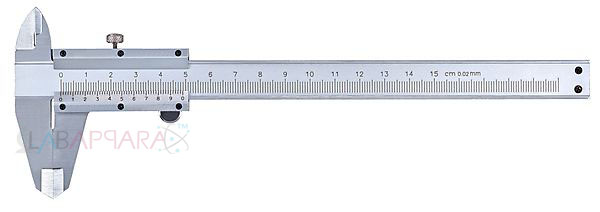
To know the use of the Vernier Calipers To know the use of the Vernier Calipers Our Objective To know the use of the Vernier Calipers. To measure the diameter of a small spherical / cylindrical body. To measure the length, width and height of the given rectangular block. To measure the internal diameter and depth of a given beaker/calorimeter and hence find its volume. The Theory What is a Vernier Caliper? A calliper is a device used to measure the distance between two opposing sides of an object. It can be as simple as a compass with inward or outward-facing points. First the tips of the calliper are adjusted to fit across the points to be measured and the calliper is then removed and the distance between the tips is measured using a ruler. The modern Vernier calliper was invented by Joseph R. Brown in 1851. It was the first practical tool for exact measurements that could be sold at an affordable price to ordinary machinists. The Vernier Calliper consists of a main scale fitted with a jaw at one end. Another jaw, containing the vernier scale, moves over the main scale. When the two jaws are in contact, the zero of the main scale and the zero of the Vernier scale should coincide. If both the zeros do not coincide, there will be a positive or negative zero error. Parts of a Vernier Caliper 1.Main Scale The main scale consists of a steel metallic strip graduated in centimeters at one edge and in inches at the other edge . It carries the inner and outer measuring jaws. When the two jaws are in contact, the zero of the main scale and the zero of the Vernier scale should coincide. If both the zeros do not coincide, there will be a positive or negative zero error. 2. Vernier Scale A vernier scale slides on the strip. It can be fixed in any position by the retainer. On the Vernier scale, 0.9 cm is divided into ten equal parts. 3. Outer Measuring Jaws The outer measuring jaws helps to take the outer dimension of an object 4. Inner Measuring Jaws The inner measuring jaws helps to take the inner dimension of an object. 5. Retainer The retainer helps to retain the object within the jaws of the Vernier calipers. 6. Depth Measuring Prong The depth measuring prong helps to measure the depth of an object. Least Count The least count or the smallest reading which you can get with the instrument can be calculated as; or First calculate the least count and only then place the object between the two jaws. Record the position of zero of the Vernier scale on the main scale. Calculating the Reading When a body is between the jaws of the Vernier Caliper; If the zero of the vernier scale lies ahead of the Nth division of the main scale, then the main scale reading (MSR) is; If nth division of Vernier scale coincides with any division of the main scale, then the Vernier scale reading (VSR) is; Total reading, Finding the Volumes Volume of a Beaker / Calorimeter Volume of the beaker / calorimeter = internal area of the cross section x depth This can be expressed as; where ‘D’ is the internal diameter of beaker / calorimeter and ‘d’ the depth of beaker / calorimeter. Volume of a Sphere where ‘r’ is the radius of the sphere. Volume of a Rectangular Block where ‘l’ is length of the block, ‘b’ the breadth and ‘h’ the height of the block. Learning Outcomes Students get to know the use of vernier calipers. Students know what is the Least count of vernier callipers