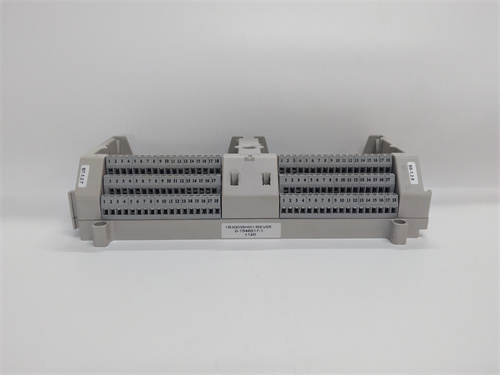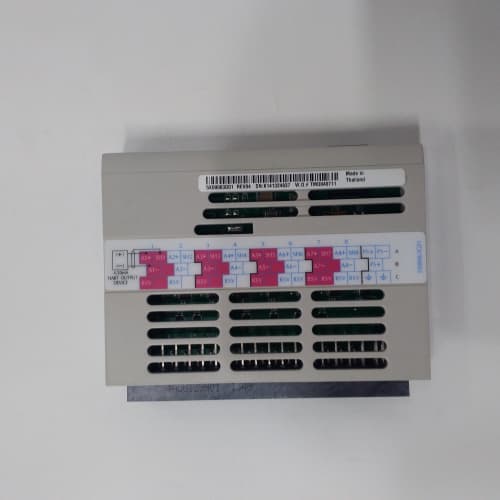
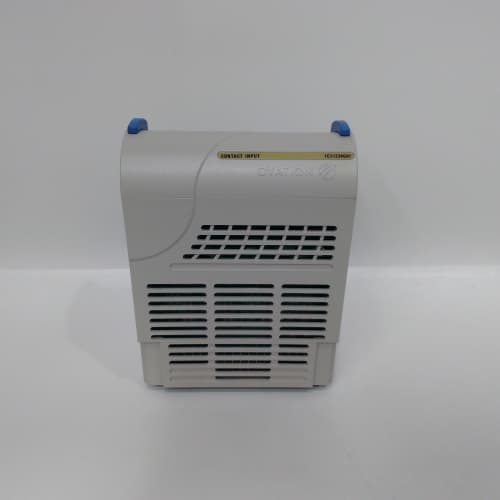
1C31113G02 | Westinghouse Ovation AO Module New Surplus
$ 96.54
Description 1C31113G02 Key Technical Specifications Parameter Specification Part Number 1C31113G02 Product Type Analog Output Module Series Ovation DCS Channels 4 analog outputs Output Type 4-20 mA current loop Resolution 14-bit (16384 steps) Accuracy ±0.1% of span typical Load Resistance 0-750 ohms maximum Update Rate 50 ms typical (configurable) Isolation Channel-to-channel, channel-to-backplane Field Power External 24V DC required (or internal optional) Indicators Module status, channel status LEDs Hot Swap Supported (with termination assembly) Power Consumption 4W typical from Ovation backplane Mounting Ovation I/O rack Operating Temp 0°C to 60°C Condition New Surplus (Original Packaging) Product Introduction The WESTINGHOUSE 1C31113G02 is a 4-channel analog output module for the Ovation distributed control system. It converts digital values from the controller into proportional 4-20 mA current signals for positioning control valves, I/P transducers, variable frequency drives, and panel indicators in power generation and industrial process applications. The 1C31113G02 features 14-bit resolution for smooth, precise analog control. Each channel is isolated, protecting against ground loops and electrical noise. The module requires external 24V DC loop power (optional internal power available on some variants) and plugs into any Ovation I/O slot with a mating termination assembly. This unit is new surplus, factory-sealed in original Westinghouse/Emerson packaging. Ovation components remain critical for power plant maintenance; contact us for current stock and firm pricing. 1C31113G02 Frequently Asked Questions (FAQ) Q: What’s the difference between 1C31113G02 and 1C31113G01? A: The G02 suffix indicates a hardware revision or enhanced version. 1C31113G02 includes: Updated component sourcing Enhanced EMC protection Improved accuracy or stability Longer lifecycle availability The older 1C31113G01 may be obsolete or have different characteristics. Always match the exact part number from your existing system. Swapping a G01 for a G02 usually works and is often an improvement, but verify with Emerson’s compatibility documentation. In critical power plant applications, we prefer to match revisions exactly. Q: Does the 1C31113G02 provide 24V loop power or require external power? A: The 1C31113G02 typically requires external 24V DC loop power. However, some variants may have optional internal loop power—check your specific module’s labeling and manual. Most Ovation installations use external power supplies for analog outputs, allowing centralized fusing and monitoring. If your existing module uses external power, stay with that. If you’re replacing a module that had internal power, verify the 1C31113G02 variant supports it. Q: What’s the resolution of the 1C31113G02, and is it sufficient for precise control? A: 14-bit resolution means 16384 steps over 4-20 mA. That’s about 0.006% of span per step, or roughly 0.001 mA resolution. This is excellent for most process control applications—valve positioning, VFD speed control, setpoint adjustment. The WESTINGHOUSE 1C31113G02 provides smooth, precise analog output without noticeable stepping. For 99% of applications, 14-bit is more than enough. Only the most demanding high-resolution applications (some analytical instruments) might need 16-bit. Q: What do the front panel LEDs indicate on the 1C31113G02? A: The 1C31113G02 has: Module status (green/red): Power and health Per-channel LEDs (yellow/green): Output status, fault indication Typical indications: Module status green steady: Module healthy Module status red: Fault (check diagnostics) Channel LED green: Output active, within range Channel LED red: Channel fault (open wire, short, out-of-range) If you see a channel red LED, check field wiring, loop power, and load first. 80% of “bad output” issues trace to field problems. Q: Is the 1C31113G02 hot-swappable in a live Ovation rack? A: Yes, with the termination assembly in place. The WESTINGHOUSE 1C31113G02 supports hot-swapping—you can pull the electronics module while the termination assembly remains wired and powered. However: All 4 outputs go offline during the swap The controller sees module fault and may take configured fail-safe actions For critical control loops (valves, drives), place in manual before swapping I’ve swapped 1C31113G02 modules live in power plants, but always with operator approval and loops in manual. The hardware handles it fine; the process doesn’t like losing control outputs. Hot-swap capability is for convenience, not for routine maintenance on live critical loops. Q: What termination assembly works with the 1C31113G02? A: The 1C31113G02 requires a mating termination assembly (TA) for field wiring. Common options include: 1C31114G01 (4-channel TA with screw terminals) 1C31114G02 (4-channel TA with compression terminals) Other variants depending on wire size and termination type The TA mounts on DIN rail, and the 1C31113G02 plugs into it from the front. You never wire directly to the module. If you’re replacing an existing module, the TA stays in place—just swap the electronics. Always verify your TA model matches the wiring configuration. Q: What’s the maximum cable length from module to field device? A: The 1C31113G02 outputs 4-20 mA, so cable length is limited by voltage drop and noise pickup. With 750 ohm maximum load and 24V supply, practical limit is about 500-1000 feet using 18 AWG twisted pair. Beyond that, voltage drop reduces the voltage available to the field device. Use this formula: V_drop = I × R_cable × 2 (round trip). If voltage at device drops below its minimum operating voltage, it won’t work. For long runs, use larger wire or install remote I/O closer to field devices. The module doesn’t limit distance; physics does. Q: What’s the typical failure mode for these modules in power plants? A: In my experience with Ovation systems: Output stage failure from surges or shorted field wiring (most common) DAC (digital-to-analog converter) drift—output accuracy degrades over time Power supply section aging—after 10 years in hot cabinets Channel-specific failure (one output dies, others work) The WESTINGHOUSE 1C31113G02 is robust, but power plants are brutal. If you lose one channel while others work, the module is damaged—replace it. For critical plant systems (boiler controls, turbine auxiliaries), keep spares. When a module fails during an outage, you can’t wait for overnight shipping. Q: Can the 1C31113G02 drive two-wire transmitters or only four-wire devices? A: The 1C31113G02 is designed for four-wire devices (valve positioners, drives, I/Ps) that have their own power. For two-wire transmitters (loop-powered devices), you need the module to provide power. If your module variant includes internal loop power, it may drive two-wire devices. If it requires external power, it’s for four-wire devices only. Check your module’s specifications and your field device type. In power plants, we typically use four-wire I/Ps and positioners with external loop power—cleaner and easier to troubleshoot. Q: Does the 1C31113G02 require configuration in the Ovation software? A: Yes. The 1C31113G02 must be configured in the Ovation engineering tool: Assign module to I/O slot Set output range (4-20 mA, 0-20 mA) Configure fail-safe behavior (on controller fault) Set output filtering (if needed) Map points to controller database If you’re replacing a failed module with an identical 1C31113G02, the configuration is already in the controller—just plug it in. For new installations, expect engineering time to configure. The module itself has no DIP switches; all setup is software-based. Q: What external fusing is required for the 1C31113G02? A: The WESTINGHOUSE 1C31113G02 does not have onboard fuses for outputs. You must externally fuse: The 24V DC loop power feeding each channel (typically 0.5-1A fast-blow per channel) The common power feed (if multiple channels share a supply) Standard practice: fuse each output channel separately. If a field wire shorts, the fuse blows instead of burning PCB traces on the 1C31113G02. I’ve seen modules destroyed because someone skipped output fusing. Don’t be that person. Q: What’s the difference between 1C31113G02 and 1C31113G03? A: The G03 suffix would be a later revision with: Updated component sourcing Enhanced diagnostics Possible feature additions The 1C31113G02 is a mature, widely deployed revision. If you have G03 in your system, use G03. If you have G02, G02 is fine. In critical applications, match exactly. For replacements, G03 may work in place of G02, but verify with Emerson’s compatibility documentation. Never assume. Q: Can the 1C31113G02 be used with HART positioners? A: Yes, for analog value only. The 1C31113G02 provides the 4-20 mA signal that a HART positioner uses for position demand. It does NOT extract or pass through HART digital data. If you need HART communication for configuration and diagnostics, you need a HART-enabled analog output module or a separate HART multiplexer. The 1C31113G02 gives you the analog control signal only. For most valve positioning, that’s sufficient. For smart positioner diagnostics, you need additional infrastructure. SA811F-3BDH000013R1 PM861AK02 PLC EMB9341-E plc 6FC5203-0AF50-3AA1 PLCDCS HONEYWELL-942-M88 PLC 475HP1ENAUGMTS PLC PF4000-C-PB-HW PLC Email: [email protected] Phone: 86 15340683922 Sales:Wu Jiedong Our products are guaranteed for 1 year, with new and original production stopped and imported spare parts. All prices listed on the official website are subject to confirmation by contact: Wu Jiedong (manager). Our product: brand new original packaging Our warranty: All new or repaired parts have a 12 month warranty period beginning Our payment: 100% telegraphic transfer of inventory items before shipment, conditions can be proposed! If you have any downtime spare parts that you cannot find, please feel free to call or use email to contact me. If there are issues that the product cannot solve, please contact me. Product prices can be negotiated. Please do not consider contacting me!
 5X00226G03 Westinghouse | Ovation 24V DC Digital Output Module